Chapter 1. Beauty and pleasure of understanding – Words of Introduction (IgalGalili).- Part I: Meeting societal challenges.- Chapter 2. The white noise of climate change (Andri SnrMagnason).- Chapter 3. Prediction and adaption in Science|Environment|Health contexts (Albert Zeyer, Nuria lvaro, Julia Arnold, Deidre Bauer, IztokDevetak, Sonja PosegaDevetak, Valentn Gavidia, Kerstin Kremer, Olga Mayoral,TinaVeselTajnSek, and AllaKeselman).- Chapter 4. Inquiry Based Learning and Responsible Research and Innovation: examples of interdisciplinary approaches at different schooling levels (Claudio Fazio, Amlia Branco, MojcaCepic, CludiaFaria, Odilla E. Finlayson, CecliaGalvo, Lus F. Goulo, Eilish McLoughlin, JernejaPavlin, DagmaraSokolowska, Wanda Viegas, Marisa Michelini).- Chapter 5. International perspectives on science education research in multicultural and multilingual contexts (MarionaEspinet, Sonya N. Martin, Alberto J. Rodrguez, SaoumaBouJaoude, Audrey Msimanga).- Chapter 6. Policy and pedagogy: International reform and design challenges for science and stem education (Richard A. Duschl, Doris Jorde, Eilish McLoughlin, Jonathan Osborne).- Chapter 7. PISA 2015: What can science education learn from the data? (Jonathan Osborne, Cory Forbes, Knut Neumann, Anja Schiepe-Tiska, Mylne Duclos, Florence Le Hebel, Andre Tiberghien, Pascale Montpied, Valrie Fontanieu, Sara Dozier, Davide Azzolini, Nicola Bazoli, Loris Vergolini).- Chapter 8. Network analysis of changes to an integrated science course curriculum over time (Jesper Bruun, Ida Viola Kalmark Andersen, Linda Udby).- Part II: Expanding the evidence base.- Chapter 9. Developmental patterns of students’ understanding of core concepts in secondary school chemistry (Sascha Bernholt, Lars Hft).- Chapter 10. Learning evolution – A longterm case-study with a focus on variation and change (Martin Scheuch, Jaqueline Scheibstock, Heidemarie Amon, Gerald Fuchs, Christine Heidinger).- Chapter 11. What is city air made of? An analysis of pupils’ conceptions of clean and polluted air (lia Tena, Digna Couso).- Chapter 12. Undergraduates’ grasp of evidence for evaluating scientific knowledge claims associated with Socioscientific Issues (Won Jung Kim, Alicia Alonzo).- Chapter 13. Psychological patterns in chemistry self-concept: Relations with gender and culture (Lilith Rschenphler; SilvijaMarkic).- Chapter 14. Undergraduate science majors’ identity work in the context of a science outreach program: Understanding the role of science capital (Alexandre Cavalcante, Allison J. Gonsalves).- Chapter 15. Pre-Service teachers’ psychological distance towards environmental and health Socio-scientific Issues (Alexander Georg Bssing, Jacqueline Dupont, Susanne Menzel).- Chapter 16. Self-efficacy of in-service secondary school teachers in relation to education for sustainable development: Preliminary findings (Athanasios Mogias, George Malandrakis, Penelope Papadopoulou, Costas Gavrilakis).- Part III: Developing innovative theoretical perspectives and methodologies.- Chapter 17. Where are we? Syntheses and Synergies in Science education research and practices (Bruce Sherin).- Chapter 18. Processes of Building Theories of Learning: Three Contrasting Cases (Andrea A. diSessa, Mariana Levin).- Chapter 19. Understanding the role of image schemas in science concept learning: can educational neuroscience help? (Tamer G. Amin).- Chapter 20. Emotional engagement in the application of experimental activities withyoung childrens (Kellys Saucedo, MaurcioPietrocola).- Chapter 21. Crossing boundaries – Examining and problematizing interdisciplinarity in science education (ShulamitKapon, Sibel Erduran).- Part IV: Designing research-based instruction.- Chapter 22. Augmented reality in lower secondary science teaching: teachers and students as producers (Birgitte Lund Nielsen, Harald Brandt).- Chapter 23. Visualisation and spatial thinking in primary students’ understandings of astronomy (Russell Tytler, Peta White, Joanne Mulligan).- Chapter 24. Discipline-based educational research to improve active learning at university (Daniele Buongiorno, Robert Harry Evans, SergejFaletic, JenaroGuisasola, Paula Heron, Marisa Michelini, GorazdPlaninSic, Paulo Sarriugarte, Alberto Stefanel, Kristina Zuza).- Chapter 25. Instructional activities predicting epistemic emotions in finnish upper secondary school science lessons: combining experience sampling and video observations (Elisa Vilhunen, XinTang, KalleJuuti, JariLavonen, KatariinaSalmela-Aro).
save
$106.00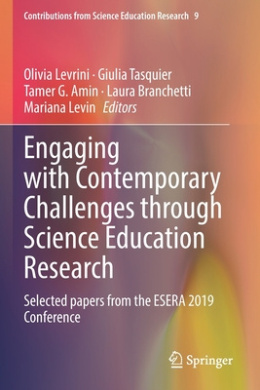
Engaging with Contemporary Challenges through Science Education Research: Selected papers from the ESERA 2019 Conference (Contributions from Science Education Research)
$13.00$119.00
Engaging with Contemporary Challenges through Science Education Research: Selected papers from the ESERA 2019 Conference (Contributions from Science Education Research), Binyan Xu, 9783030744922
| Publisher | |
|---|---|
| ISBN | |
| Date of Publishing | |
| Author | |
| Category | |
| Page Number |